You might remember
my first foray into the world of no-dig vegie gardening. I followed a recipe by Stephanie Alexander, and used bales of straw and lucerne as the garden 'edges'. I can now report on the success of that experiment, and I have to say - I wouldn't do it that way again. Perhaps last summer was a particularly wet one here in Brisbane, but those bales rotted down so fast that very quickly, TOO quickly, they had decomposed and my lovely piles of compost and manure (that the bales were supposed to be containing) were oozing gracefully out into the surrounding ground, taking my lush vegies along for the ride. Additionally, it became hazardous to try and pick things from the garden, as I had to step onto the rotting bales to reach anything, and of course stepping on them squashed them even further. Perilous!
Here's what a bale looked like once decomposed. I think this one was lucerne.
You can see the blue baling twine mixed in with the rotted bits of lucerne (and some opportunistic tomato seedlings) as well as the even-more-well-rotted remains of the bale. Lots of fabulous compost, yes. Garden edge? Not any more.
Over summer, the vegie garden as a whole got a bit buggy, and then overrun with pumpkin. Anything leafy (like the spinach, purple sprouting broccoli and kale) got infested with cabbage moths and aphids, and the whole thing was in a rather sorry state. I let the pumpkin do its thing and then a month ago the whole vine suddenly went yellow and died, prompting me to harvest about eight good-sized pumpkins, and a stack of smaller ones that had stopped developing but proved to still be edible.
With the absence of pumpkin the garden revealed itself - or should I say, the
lack of garden revealed itself. All I had left of the first garden (I had made two, the first before last winter, and another before last summer) was a very large pile of ex-garden that began to slide alarmingly down the yard with every bit of rain. (Curiously, one such slide did reveal a secret crop of sweet potatoes who had been lurking beneath the pumpkins.) But action was required, and as usual, C came up with the necessary arm strength.
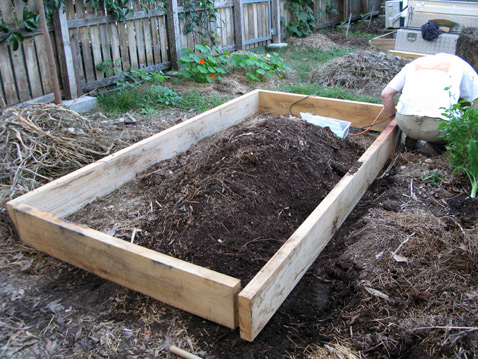
Here it is - a simple wooden edge using untreated timber. Getting untreated timber is important (it was ordered in by the timber merchant as they didn't have it in stock) as I don't want any of the chemicals used to preserve timber to leach into the soil and therefore into our vegies.
I should add here that the reason that I didn't dig that compost straight into the ground is that we live in an area where the natural soil is not soil at all - it's solid clay, and so any garden needs to to be built up on top of it for best chance of success.
Anyway, C made me two lovely timber-edged beds, which take up about the same area as one of the original straw-bale-edged beds. I admired his handiwork for a while and then took a look at what remained from the original bed. After pulling out all the blue baling twine, I mixed up the decomposed bales with the original 'lasagne' from the no-dig bed - the layers of lucerne, compost, manure, straw and Hydrocell. Here's what's left:
A lovely mulchy mix, full of little munching insecty bugs (and some of those appalling Gigantor lawn grubs that even the chooks have difficulty touching, let alone eating) and well-rotted straw, and even some of the original Hydrocell (above, that's the big white clump) water-retaining stuff.
So, this year I'm going with a tweaked version of Stephanie's no-dig lasagne recipe from last year. I put a thick layer of cardboard down on the ground first, (under the edges of the timber, to stop grass coming through) followed by a layer of lucerne in chunks about ten centimetres thick. Over the top of that I spread the remainders from last year - that's the big pile you can see in the photo above. That just about filled the timber to the top - but it will all settle quite a lot, so I kept piling stuff on.
Four bags of sheep manure, followed by two big bags of Searle's Compost Mix. I love the Searle's Compost Mix - it's got fish and seaweed and worm castings already added to the compost, making it a very rich mix. I grew last year's potatoes in it, neat, and they were grand!
I then forked the whole lot over gently, taking care not to disturb to the lucerne layer. A bit of water to help it settle and I think this will be ready to start planting. I'm keen to get some greens in - and very interested to see how this works compared to last year. I hope to have good things to report in a few weeks - fingers crossed, hey?