Showing posts with label vegetable garden. Show all posts

Wednesday, October 2, 2013

... on plants.

There has been so much going on in the garden recently. It seems that just about every day there's been something new to sniff. One of my favourite flowers as far as scent goes are those little old-fashioned white freesias. This year I got a stack of bulbs from The Digger's Club and put them in a big shallow pot on the deck.
The native bees are still around, and it seems they like freesias too. Look at their little pollen balls!
My big pots of pansies, heartease and anemones have been flowering spectacularly for weeks. I don't think I've ever had such success with flowers in pots before!
The vegie garden (with the new hardwood edges) is packed full of greens, and they're now at the stage where we can hardly keep up with the output and need the chooks to help out! There's some carrots up the back there too, they should be ready in a couple of weeks.
 
This morning there was a first flower on my extra-special purple beans. I do so love purple food.
Speaking of chooks, (who are somewhat garden-related as that's where they live) Marilla had been sitting in an expectant trance for three weeks. Over three weeks, actually, as it took me about ten days to source some fertile eggs for her!
Of the twelve eggs, five hatched, which isn't a bad result considering the eggs came through the post. There was a possibility none would hatch, as who knows what happens to a fragile package en route? But there's now five one-week-old Pekins cheeping in their coop, which is just a wonderful thing. 
Look at those feet! Time for me to go and pick a colander of greens for our dinner, and squeeze a few chicks. Not a bad way to finish the afternoon!

Friday, July 12, 2013

... on making dirt.

You might remember my first foray into the world of no-dig vegie gardening. I followed a recipe by Stephanie Alexander, and used bales of straw and lucerne as the garden 'edges'. I can now report on the success of that experiment, and I have to say - I wouldn't do it that way again. Perhaps last summer was a particularly wet one here in Brisbane, but those bales rotted down so fast that very quickly, TOO quickly, they had decomposed and my lovely piles of compost and manure (that the bales were supposed to be containing) were oozing gracefully out into the surrounding ground, taking my lush vegies along for the ride. Additionally, it became hazardous to try and pick things from the garden, as I had to step onto the rotting bales to reach anything, and of course stepping on them squashed them even further. Perilous!

Here's what a bale looked like once decomposed. I think this one was lucerne.
You can see the blue baling twine mixed in with the rotted bits of lucerne (and some opportunistic tomato seedlings) as well as the even-more-well-rotted remains of the bale. Lots of fabulous compost, yes. Garden edge? Not any more.

Over summer, the vegie garden as a whole got a bit buggy, and then overrun with pumpkin. Anything leafy (like the spinach, purple sprouting broccoli and kale) got infested with cabbage moths and aphids, and the whole thing was in a rather sorry state. I let the pumpkin do its thing and then a month ago the whole vine suddenly went yellow and died, prompting me to harvest about eight good-sized pumpkins, and a stack of smaller ones that had stopped developing but proved to still be edible.

With the absence of pumpkin the garden revealed itself - or should I say, the lack of garden revealed itself. All I had left of the first garden (I had made two, the first before last winter, and another before last summer) was a very large pile of ex-garden that began to slide alarmingly down the yard with every bit of rain. (Curiously, one such slide did reveal a secret crop of sweet potatoes who had been lurking beneath the pumpkins.) But action was required, and as usual, C came up with the necessary arm strength.
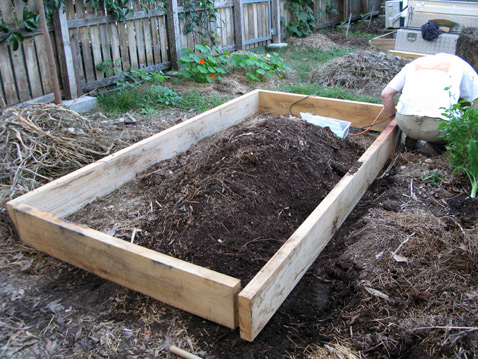
Here it is - a simple wooden edge using untreated timber. Getting untreated timber is important (it was ordered in by the timber merchant as they didn't have it in stock) as I don't want any of the chemicals used to preserve timber to leach into the soil and therefore into our vegies.

I should add here that the reason that I didn't dig that compost straight into the ground is that we live in an area where the natural soil is not soil at all - it's solid clay, and so any garden needs to to be built up on top of it for best chance of success.

Anyway, C made me two lovely timber-edged beds, which take up about the same area as one of the original straw-bale-edged beds. I admired his handiwork for a while and then took a look at what remained from the original bed. After pulling out all the blue baling twine, I mixed up the decomposed bales with the original 'lasagne' from the no-dig bed - the layers of lucerne, compost, manure, straw and Hydrocell. Here's what's left:

A lovely mulchy mix, full of little munching insecty bugs (and some of those appalling Gigantor lawn grubs that even the chooks have difficulty touching, let alone eating) and well-rotted straw, and even some of the original Hydrocell (above, that's the big white clump) water-retaining stuff. 
So, this year I'm going with a tweaked version of Stephanie's no-dig lasagne recipe from last year. I put a thick layer of cardboard down on the ground first, (under the edges of the timber, to stop grass coming through) followed by a layer of lucerne in chunks about ten centimetres thick. Over the top of that I spread the remainders from last year - that's the big pile you can see in the photo above. That just about filled the timber to the top - but it will all settle quite a lot, so I kept piling stuff on.
Four bags of sheep manure, followed by two big bags of Searle's Compost Mix. I love the Searle's Compost Mix - it's got fish and seaweed and worm castings already added to the compost, making it a very rich mix. I grew last year's potatoes in it, neat, and they were grand!

I then forked the whole lot over gently, taking care not to disturb to the lucerne layer. A bit of water to help it settle and I think this will be ready to start planting. I'm keen to get some greens in  - and very interested to see how this works compared to last year. I hope to have good things to report in a few weeks - fingers crossed, hey?

Tuesday, February 12, 2013

... on drought, flood and pestilence.

I took the camera out into the vegetable garden this morning so I could share with you the disgrace that has befallen my two Stephanie Alexander no-dig vegetable garden beds. You may remember how luscious they were looking towards the end of last year. Since then it's been hot, it's been wet, it's been windy, it's been dry, it's been humid, it's been harsh, and as a result most things have turned up their toes. I'm hesitant to replace them because of the hordes of insects that are munching on anything that dared to survive.
But you know what? I went out to capture the shame, but in fact I found some good stuff going on!
The first bed is sprawling with pumpkin plants, who have happily spread beyond the garden and colonised the entire back corner of the yard. Although all the tiny pumpkins have rotted off due to rain and humidity (I think), I have hopes that soon the weather will be in their favour and it'll be pumpkin-a-go-go around here. Other than the pumpkins there's some caterpillar-fodder purple-sprouting-broccoli, some pestilential remnant silverbeet and one tiny patch of self-seeded rocket. True to its name it's bolting to seed almost before we can eat any of it but if I'm quick enough I can grab a leaf or two for a salad.
In the second bed the kale is slowly making a come-back after some months of being ravaged by a horrible spider-webby caterpillar - I think it's a two-year type plant so I hope it will continue to crop over the coming cooler months once the bloody bugs die off! There's also one valiant eggplant continuing to struggle against daily assaults by the local birds (chooks included) who have proven they will dig DEEP to get a taste of the Hydrocell water-saving stuff that is in that bed. Apparently it's non-toxic... I hope so, because there's some maggies and crows around here with a serious addiction!

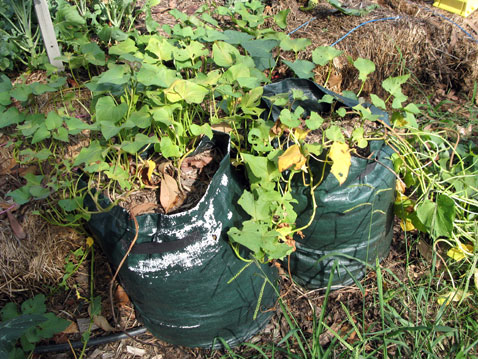
I checked out the sweet potatoes which have been growing in bags since last year. One bagful looked a bit wilty (and the bag ripped when I attempted to move it - looks like those spud bags will only last for two crops) so I tipped it out to see what was going on.
Sweet potatoes, and a decent amount of them, too! They're a bit holey in parts but I'm not too bothered - not when one tiny bag can produce a big spud like this:
The little fig tree is another thing that has seemed to flourish after the hot/wet/humid rollercoaster Brisbane has been on for the past month or so. It's sprouted so many new branches I've had to stake it to stop it falling over, and is covered in tiny little figlets.
I'm feeling positive about the garden, as the nastiest (and most unrelenting) part of summer should be behind us now. I'm looking forward to re-planting it all out with cooler-weather things once February is over and who knows? I may have an awesome pumpkin crop to report upon soon!

Sunday, January 13, 2013

... on The Best Pizza Ever!

I have had a very useful visitor to the vegie garden - a rogue cherry tomato. I didn't plant him - he just came up by himself. I gave him a stake and he grew big and robust and started popping out what seemed like tonnes of tasty cherry tomatoes.
What to do with such a wonderful free glut of tomatoes? Pizza sauce, of course!

I think the secret to a really good rich pizza sauce is to roast your onion, garlic and tomatoes together in a pan with a coating of olive oil, because it just bring out all the flavours in the most delicious way. Whiz it all up in a food processor with salt, pepper and any herbs you care to add. I use oregano and basil, because I happen to have them in the herb garden at the moment. I also prefer red onion over brown or white, but that's just me. I like purple food.
In one batch I would use, say, two (or three small) red onions (peeled and quartered) to one colander of washed cherry toms, with peeled garlic cloves to taste (I use about ten, and you don't have to chop them because you're going to whiz them later), roasted with a decent whack of olive oil in a heavy pan at 180 degrees centigrade for about 30-40 minutes. 

When it's all cooled down a bit, I put it in a food processor with about a teaspoon of Maldon sea salt (that sounds like a lot - but Maldon in particular is less 'salty' than others and the flakes are really large - so less fit when measured), some pepper, herbs and if I happen to have a bottle open, a slug of red wine. Whiz as much as you fancy - the more you whiz the smoother the sauce.

This would make enough for about 6 regular-sized pizzas. I divide it up into small containers and freeze them so I have sauce on hand for whenever pizza is required - quite regularly!

The rest - take your pizza base of choice (I use sourdough leftovers from when I've made bread - it gets partially cooked before the sauce goes on. This makes sure that it doesn't go soggy) and spread it evenly with your lovely new pizza sauce.
Add toppings. For this one I used kalamata olives and chopped silverbeet, and then lots of pizza cheese (which is a ready-grated mix of mozzarella, parmesan and cheddar).
This all goes in a very hot oven (the hottest it will go - on ours the maximum is 200 degrees centigrade) until it's all melty and brown on top. Check it after ten minutes, and watch it - it seems like there's only a few minutes between pizza perfection and charred cheese!
Consume immediately, with gusto. If you have any of that bottle of red left, this would be the perfect thing to go with it.

Thank you little rogue cherry tomato! Please visit us again!

Monday, November 5, 2012

... on a garden update.

This is what awaited me out the back when I got home after being away for five weeks.
A garden full of green things! As there had been no rain, and as Brisbane had just been blasted by a long period of that horrible dry gusty westerly wind, I wasn't expecting this. The tiny kale plants I'd hurriedly planted before heading off to the airport looked promising. The row of Florence fennel was outstanding! And, although windswept, the corn at the back was flowering and covered in tiny cobs.  
I'm not sure why some of the tiny corn cobs have this lovely red silk, and others green, as all the seeds were the same. They are an organic heirloom variety from Diggers called Golden Bantam.
Aren't the little pink flowers beautiful?
Another surprise delighted me - it looks like the sweet-potato experiment is a success, as least from a vine-growing perspective! Whether there's lovely tubers forming in those bags is yet to be determined - I think it's way too early yet.
But, I can almost taste that corn already. A few more weeks!

Thursday, May 24, 2012

... on a garden update.

For a while there it seemed like nothing was happening... and now look!
The zucchinis are well on their way to proving right their claim that "one plant can feed an entire postcode." The silverbeet is doing MUCH better than it looks because... well, we keep eating it. Too-thickly-planted garlic could become an issue but I didn't expect them all to survive, and the shelling peas along the back have put out their first tendrils reaching upwards for their wire support.
I have three pots of blueberries, one of which has already developed some convincing-looking fruit. How sweet are these blueberry flowers? That ant thinks so too.
The spuds... oh boy. That first lot I put in are already bursting out of the top of their bags! I've learned something along the way about growing potatoes in bags... to be careful about adding more soil/compost as the plants grow. I covered over some of the smaller shoots (thinking they'd push their way through) and they just rotted. Luckily I was harbouring a suspicion that I'd put too many spuds in each bag, so it could be for the best! I think the casualties were the red ones, so I've planted more, and they've just come up. Sweet reddish shoots!
 ... and the marigolds are for the bugs! Oh happy garden!

Thursday, April 26, 2012

... on speaking too soon!

... and the next time I looked, there they were! Hello zucchini!

Sunday, April 22, 2012

... on what's going on in the garden?

My thumbs have a greenish tinge! There has been the planting of a punnet of silverbeet. I believe they're Fordhook Giant.
There has been the cutting and drying of two types of sprouting potatoes, Sebago and another one with a red skin and lovely pinkish flesh, the name of which I don't know.
There has been the planting of these potatoes into some spud bags from the Diggers Club. I'll be removing that straw from the top - it's been hot here for the past few days and I wanted to keep the moisture in the bags for a bit.
There has been the purchase and installation of a large Aerobin compost bin. It's the type that has a collection tank at the bottom for the lovely compost liquid that you can use to give your plants a boost.

Thankyou C for making me such a lovely concrete slab to put the compost bin on! Now it won't slide down the hill when it rains and a torrent starts up through this spot. 
What else? My kale seeds have come up! I'm quite happy about that as they only took a couple of days. I haven't grown kale before but I love it panfried with gnocchi and smoky bacon.
No sign of the zucchinis yet though.  
Patience! Not my strongest trait, I must say!

Friday, April 13, 2012

... on a garden. A garden!

Things are feeling a little more settled here - I'm not feeling quite so displaced! This morning I did something that's been on my wish-list for a very long time, and has made this place feel far more like home.

I've always been somewhat keen on growing vegetables - when I was a kid my Dad had a Howard rotary hoe (imaginatively named 'Howard') and our whole front paddock was given over to vegie growing. One of my favourite tasks was to tuck a chicken under one arm and go and de-caterpillar the cabbages and broccoli. Being able to eat beans straight off the bush was just fab, and shop-bought vegies (or heaven forbid, frozen!) just didn't compare.

One of the things that's been on my to-do list for ages is 'Have an awesome vegie garden.' This new house - it's built on solid clay, and by 'solid' I mean 'there's a brickworks down the road'. Clay is not really a friend to gardeners, so I pulled out my trusty Stephanie Alexander's 'Kitchen Garden Companion' book and asked her advice. Stephanie always knows what to do. The solution jumped out. Clay = don't dig down, build up. No digging required!
Click on this - it'll probably be big enough should you like to read it.
I love Stephanie Alexander. She's a national treasure. For those who don't know, Stephanie is a cook, writer and gardener who has started a program for Australian primary schools where the kids build a kitchen garden and grow some vegies, learning about where some of their food comes from. They harvest their crops and cook them, finding out about nutrition and health too. You can find out more about it here.

So, here's my opportunity to try Stephanie's recipe for a no-dig garden. The idea is you build up layers of material (lasagne style) and the growing plants get their roots down into it and ideally, thrive. You can even do it on top of concrete - a garden for anywhere! Our clay soil is almost concrete - I don't know how the grass survives.

First layer = a good whack of newspapers/cardboard. I don't want the grass growing up through the vegies.
I did get a little distracted by this article about Tom Waits, but hell... gardening is for enjoyment too, right? I added him to the pile once I'd read it.
I'm using bales of hay/lucerne as the edges for my garden. They're somewhat temporary and will break down into lovely rich mulch in a year or so. Plus I can try a bit of 'straw bale' gardening (growing things straight into the bale) as a side project.
Next is a thick layer of lucerne. Stephanie describes the process of disassembling the bale as 'peeling away like big Weet-Bixes' and she's completely right. Water it down with a couple of watering-cans full of seaweed mix, too.
Then comes a layer of manure (I'm using sheep) mixed in with Hydrocell. This is a very interesting product - it retains water and releases it slowly to the plant, meaning you don't need to water as often or as much. It's available at Centenary Landscaping Supplies here in Brisbane - and it was tricky to find. I'd looked about at various hardwares, garden and produce shops before Consulting The Internet to find a supplier. Darn it, I should have done that first.
Next is a thick layer of straw. Stephanie's recipe calls for 'pea straw' but you just can't get that in Brisbane. Ordinary straw will have to do - I hope that's not a fatal error. Wet it all down with a few more cans of seaweed fertiliser.
 Then, yet another layer of the manure/Hydrocell mixture.
 The whole lot gets topped off with a thick layer of compost and watered. Apparently it'll be ready for planting straight into the compost mix in a few days - I'll give it a week.
So... here begins my no-dig vegetable garden experiment. One thing though... this costs an arm and a leg. I estimate that the materials to make two square metres of garden cost around three hundred dollars. If I'm not able to report back with some promising vegie-garden news I'm going to... be... very... disappointed!